AV Services · avservices.in · Mumbai, India
Claims Are Easy. Documents Are Not.
Anyone can write a company history. Anyone can list clients, describe engagements, and claim decades of experience on a website. The infrastructure management market is full of companies whose credentials exist primarily as marketing copy — asserted confidently, impossible to verify, and accepted on faith by clients who have no mechanism to confirm what they are being told.
AV Services operates differently.
Every material claim made about this company’s history, its client relationships, and its professional certifications is backed by a physical document. Signed. Stamped. Dated. On file. Available to prospective clients who want to see them before making a decision about who to trust with their production infrastructure.
This page exists because trust in an infrastructure partner should not be based on faith. It should be based on evidence. Here is the evidence.
The Standard We Hold Ourselves To
Before listing the credentials, it is worth explaining why documentation matters in this specific context.
You are evaluating whether to grant access to your production servers to an external party. Those servers run your application, hold your customer data, process your transactions, and underpin everything your business does online. The decision to trust someone with that access is consequential. It should be made on the basis of verified information, not marketing assertions.
AV Services has held itself to this standard from the beginning. Not because it is required — nobody requires it. Because the alternative, claiming credentials that cannot be verified, is incompatible with the professional integrity that infrastructure management demands. A company that is careless about the accuracy of its own claims is not a company you want making decisions about the accuracy of your backup configuration.
Every credential on this page is documentable. Every document cited exists in physical form. None of these claims require you to take AV Services at its word. They require only that you ask to see the document, which any serious prospective client is welcome to do.
Pyramid Computer GmbH — Certified Technology Partner
Date: December 15, 2009
Issuing organisation: Pyramid Computer GmbH, Freiburg im Breisgau, Germany
Nature of credential: Formal Technology Partnership Certificate
Documentation: Signed and stamped certificate, on file
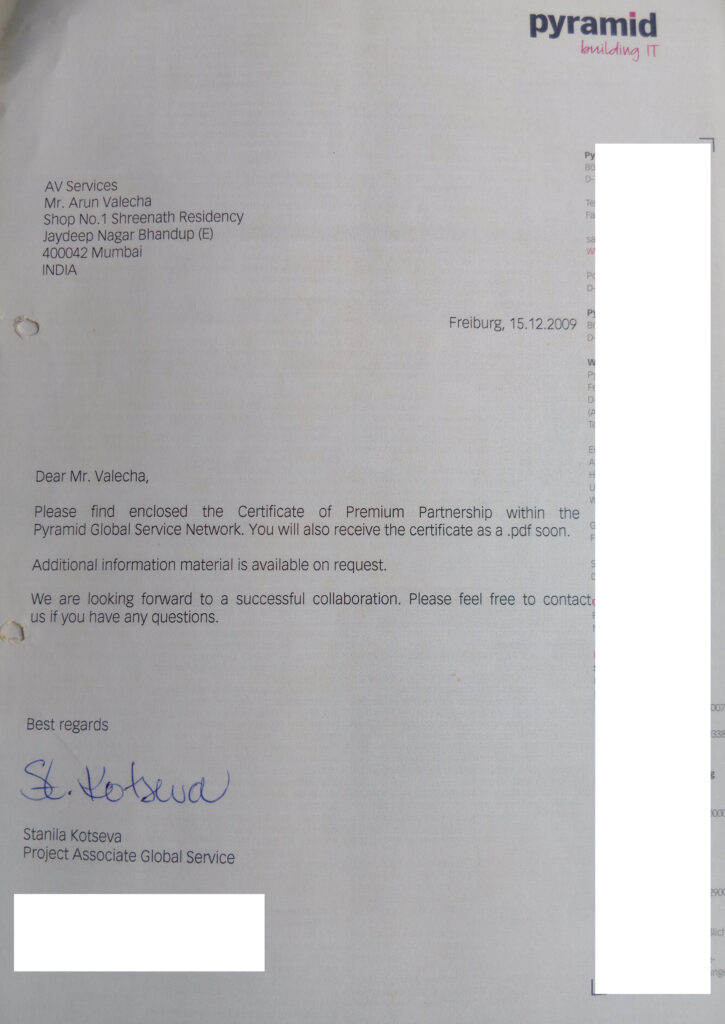
Pyramid Computer GmbH is a German manufacturer of specialised computing infrastructure — high-availability systems for industrial, medical, and enterprise applications. They are not a company that issues partnership certifications as a marketing exercise. Certification as a technology partner requires demonstrated technical capability and a formal evaluation process.
In December 2009, AV Services was formally certified as a Technology Partner by Pyramid Computer GmbH. At the time, AV Services was among a very small number of Indian independent professionals to hold European vendor certification in this domain.
The certificate is signed by Pyramid Computer GmbH’s authorised representative, stamped with the company’s official seal, and dated December 15, 2009. It is a physical document, not a digital badge or a self-reported credential. It predates by years the current practice of issuing digital certificates that can be generated by anyone with access to a certificate template.
What this credential means in practice: a European technology company, operating to European professional standards, evaluated AV Services and found the quality of work sufficient to warrant formal certification. That evaluation was conducted by an independent third party with no interest in certifying anyone who did not meet the standard.
Comtech Services Inc — Approved Field Service Vendor
Period: 2013 – 2014
Engaging organisation: Comtech Services Inc, United States
Nature of engagement: Approved on-ground field service vendor in India
Documentation: Signed Field Service Reports, on file
Comtech Services Inc is a US-based technology services company. Between 2013 and 2014, AV Services was engaged as an approved field service vendor in India — selected, vetted, and approved to deliver on-ground technology services to Comtech’s Indian client base on their behalf.
Vendor approval by an American technology company is not a casual process. It involves evaluation of technical capability, documentation standards, professional conduct, and the ability to operate to the service protocols that US companies require of their approved vendors. AV Services met that evaluation and was engaged on that basis.
The engagement is documented by signed Field Service Reports — physical documents, bearing the signatures of the relevant parties, recording the work performed to US-standard documentation requirements. These reports are on file and available to prospective clients on request.
This engagement is significant for two reasons beyond the credential itself. First, it demonstrates that AV Services was operating to international professional standards as early as 2013 — not adapting to international requirements, but meeting them as a matter of established practice. Second, it is the first of two independent validations by American companies in overlapping periods — a pattern that is worth noting.
Source Support Services Inc — Onsite Work Order Partner
Period: 2013 – 2015
Engaging organisation: Source Support Services Inc, United States
Nature of engagement: Sustained onsite work order partner for technology service delivery across India
Documentation: Signed Work Orders, on file
Source Support Services Inc is a second US-based technology services firm. Between 2013 and 2015 — a period that overlaps with the Comtech engagement and extends beyond it — AV Services served as an onsite work order partner for Source Support, delivering technology services across India on their behalf.
Two points about this engagement deserve specific attention.
The first is duration. This was a two-year sustained engagement, not a one-off project or a single work order. A two-year relationship with an American technology company, maintained over that period because the quality of work warranted continuing it, is a different kind of validation than a single completed transaction.
The second is independence. Comtech Services Inc and Source Support Services Inc are separate companies. They made their engagement decisions independently. Two independent American companies, in the same period, choosing the same Mumbai-based specialist is not a coincidence. It is a consistent signal about the quality of work being produced.
The engagement is documented by signed Work Orders — physical documents recording each engagement, bearing appropriate signatures, meeting the documentation standards required by US technology service companies. These documents are on file and available to prospective clients on request.
Indian Business Clients — Verified by Purchase Orders
Period: 2003 – 2010
Number of clients: 12+
Nature of engagements: Linux and IT infrastructure services — sustained partnerships
Documentation: Signed and stamped Purchase Orders, on file
Between 2003 and 2010, AV Services served more than twelve Indian businesses as their primary IT infrastructure partner across Mumbai and Maharashtra. These were not short-term engagements. They were sustained relationships, built over years, with businesses that chose to continue the partnership because the work was reliable and the results were consistent.
Several of these client businesses were subsequently acquired by larger Indian conglomerates — companies that had grown, in part, on infrastructure that was professionally managed. The acquisitions are a matter of public record for the companies concerned.
Each client engagement during this period was conducted on formal Purchase Orders — signed, stamped documents recording the commercial relationship between AV Services and the client. These Purchase Orders constitute primary source documentation of the engagements. They are on file. They are available to prospective clients who want to verify the claim that AV Services has been serving Indian businesses since 2003.
The significance of this documentation is not only the individual client relationships it records. It is the decade-long pattern it represents — a consistent record of businesses choosing AV Services, paying for the service, and continuing the relationship — that is the foundation on which everything that followed was built.
AV Services — Active Since 1999
Founded: 1999, Mumbai, India
Current status: Active
Years in continuous operation: 25+
AV Services has been in continuous operation since 1999. Not relaunched. Not rebranded after a gap. Continuously operating, in the same discipline, from the same base in Mumbai, for 25 years.
Longevity in business is not, by itself, a credential. A business can operate for 25 years without doing excellent work. But longevity combined with a documented record of client relationships, international certifications, and verified engagements with companies from three different countries tells a coherent story — not a story that was assembled for a marketing page, but a story that happened, over 25 years, and is documented in the physical records that companies keep when real work is done.
The significance of 25 years of continuous operation in Linux infrastructure specifically is also worth noting. The Linux landscape has changed fundamentally over that period. The best practices of 1999 are not the best practices of 2024. Staying relevant across 25 years in a field that does not stand still requires ongoing investment in knowledge, tools, and practice. The companies that built a reputation in Linux infrastructure in the early 2000s and are still operating — and still serving clients — did not achieve that by coasting on historical knowledge. They achieved it by staying current.
How to Verify These Credentials
Every credential listed on this page can be verified. The process is straightforward.
Contact AV Services at arun@avservices.in and indicate which credential you would like to verify. The relevant documentation will be made available to you — scanned copies for initial review, with originals available for inspection in person for clients who require it.
There is no complex process. No waiting period. No redacted documents with the relevant information removed. The documents that verify these credentials are complete, legible, and available to any serious prospective client who asks to see them.
This is not a common practice in the infrastructure management market. Most companies, when asked to verify their credentials, respond with case studies, references, and testimonials — secondary sources that can be curated and shaped. AV Services responds with the primary documents themselves.
The reason is simple. If you are considering granting access to your production infrastructure to an external party, you should be able to verify who you are trusting. AV Services believes in making that verification as easy as possible. The documents exist. The history is real. The verification is available.
Ask for it.
A Note on What These Credentials Are Not
Credentials are evidence of past performance. They are a reasonable basis for confidence in future performance. They are not a guarantee of it.
AV Services does not present these credentials as proof that nothing will ever go wrong on a managed server. Infrastructure is complex. Hardware fails. Software has bugs. Networks are unpredictable. A managed server is significantly less likely to experience a preventable incident than an unmanaged one — but it is not immune to all incidents.
What these credentials demonstrate is a track record of professional conduct, technical competence, and client relationships that have been sustained over time and verified by independent third parties. That track record is the most reliable predictor available of how an engagement is likely to go.
It is a better basis for a decision than marketing copy. It is not a substitute for your own judgement. Both things are true simultaneously.
Contact
Email: arun@avservices.in
Website: avservices.in
To request credential documentation: arun@avservices.in
Response to documentation requests: Within one business day
AV Services · avservices.in · Mumbai, India Linux Infrastructure Care & Maintenance Since 1999 Certified Partner — Pyramid Computer GmbH, Germany · Approved Vendor — Comtech Services Inc, USA · Work Order Partner — Source Support Services Inc, USA