Silence is not a status report

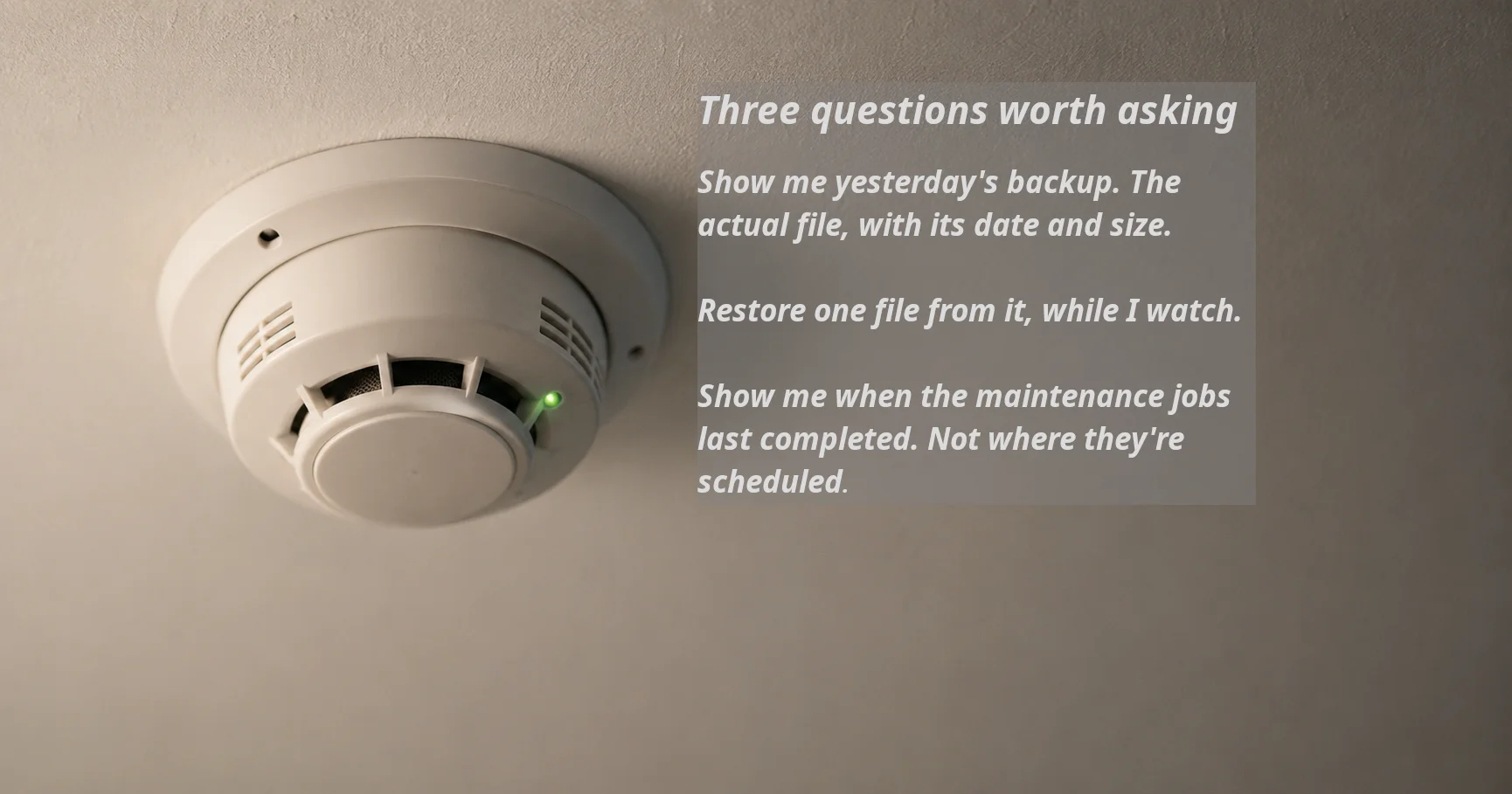
The smoke detector in your hallway chirps when its battery runs low. Annoying, yes. Also the most honest piece of engineering in your house.
Somebody, decades ago, understood a dangerous fact: a dead smoke detector looks exactly like a healthy one. Silent. Mounted. Reassuring. So they built in a complaint. The device refuses to fail quietly.
Most computer systems never got that memo.
The quietest disasters
I’ve looked after Linux servers since 1999, mostly for manufacturers, jewellers and stockbrokers around Mumbai. In 27 years, the failures that did real damage were almost never loud. No sparks, no error on anyone’s screen. Just silence, misread as health.
A backup folder where the newest file is months old, while everyone in the office believes backups run nightly. A maintenance job that sits on the schedule like an appointment in a diary, except the machine never actually kept the appointment. A disk filling up by a few hundred megabytes a day for weeks, with the website loading fine the whole time, right up until the morning it doesn’t.
The worst one I walked into had quietly stopped backing up four months earlier. The dashboard showed green every single day in between. They found out the morning they needed a file that no longer existed in any working copy. I’ve written about a similar case in detail: The backup that was never there.
I’ve lost count of how many versions of these I’ve seen. The pattern is always the same: the system stopped working long ago, and nobody knew, because nobody heard anything.
And why would they? We read silence as safety. A quiet baby is a sleeping baby. It’s a fair instinct in a house.
It fails completely for servers. Here’s why.
The messenger dies with the message
Most monitoring is built on one assumption: when something breaks, it will tell you.
But think about what breaking actually does. A full disk can’t write the log entry that says the disk is full. A crashed program can’t send the email announcing its own crash. A server that loses power doesn’t get a last word. The failure kills the messenger along with everything else.
So “no alerts today” carries far less information than it seems to. It could mean everything is fine. It could mean the alerting system itself died in March. From your inbox, the two are indistinguishable.
Railways solved this a century ago. A train driver holds down a pedal, the dead man’s switch, and must keep proving he’s alive and alert. Release it, and the train assumes the worst and brakes. The railway never waits for the driver to report a problem. It demands continuous proof that things are right.
That single reversal—demanding proof of success instead of waiting for reports of failure—is the whole lesson.
Three questions worth asking
You don’t need to be technical to apply this. If someone manages servers for your business (an employee, a vendor, a cousin who’s good with computers), ask them these, once a month:
“Show me yesterday’s backup. The actual file, with its date and size.” A green tick in a dashboard proves a script started. A file dated yesterday, of roughly the expected size, proves it finished. See how we handle this for retainer clients: Linux backup and recovery.
“Restore one file from it, while I watch.” This is the question almost nobody asks. A backup that has never been restored is a rumour. I’ve seen businesses pay for backup storage for years and discover, on the worst possible day, that the files inside were unreadable. Ten minutes of restoring one document, once a month, ends that risk.
“Show me when the cleanup and maintenance jobs last ran. Ran, completed, finished. Don’t show me where they’re scheduled.” The gap between scheduled and done is where quiet disasters live. If you’re not sure how to verify this, start here: How to check if a Linux cron job actually ran.
If the answers come quickly, you’re in good hands. If the answers are “it’s all automated, don’t worry,” worry a little. Automation is exactly the thing that fails silently.
Make silence the alarm
There’s a deeper version of this for anyone who builds or buys systems: flip the default.
A healthy system should produce a small, regular proof of life. Yesterday’s backup confirmation. A weekly one-line report: jobs ran, disk at 40%, all services up. Boring on purpose. This is exactly what our monthly client reports are built around. And the moment that boring signal stops arriving, that’s your alarm. You stop listening for screams and start noticing missing heartbeats.
This costs almost nothing to set up and it changes what silence means. Today, silence means “probably fine, who knows.” After the flip, silence means “go look, now.” One of those is a status report. The other is a guess.
Your smoke detector figured this out before the internet existed. It would rather chirp at you at 3 a.m. than let you trust a dead device.
Build like the chirp. Manage like the chirp. The systems that protect you should be incapable of failing politely.
Arun Valecha has managed Linux server infrastructure for Indian businesses since 1999. He runs AV Services (avservices.in), a Mumbai-based Linux infrastructure practice serving manufacturing, jewellery, broking and healthcare clients. Not sure if your systems are set up to fail quietly? Request a free Linux server audit.
Silence usually means nobody’s watching, not that nothing broke. If you’ve just discovered something is actually gone, see Linux Data Recovery — no cure, no pay.